A Rainy Walk for Noticing Building Materials
A rainy walk for noticing building materials reveals how stone, metal, glass, and masonry guide runoff, so you can read building details safely from the sidewalk.
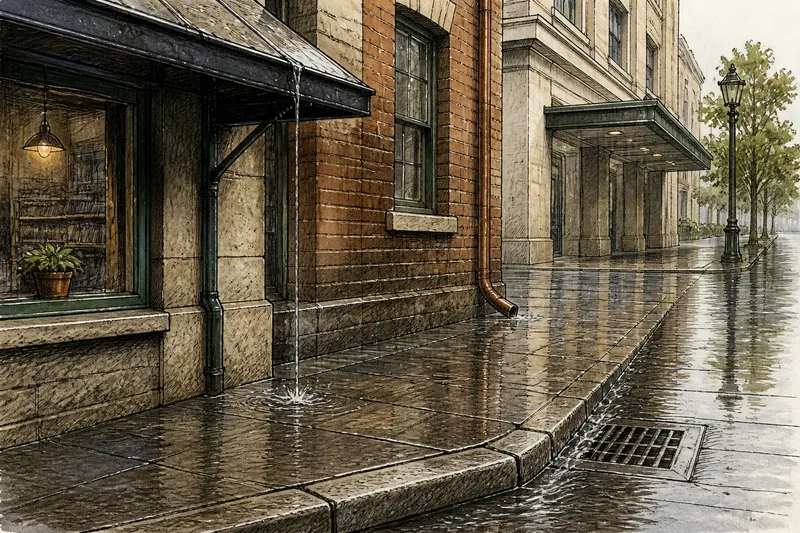
Rain darkens the granite curb outside a corner shop while water slips from its metal awning in a narrow line. A rainy walk for noticing building materials turns familiar streets into a chance to see how ledges, joints, and paving shape the movement of water. The point is not to judge a building’s condition, but to notice how its visible details meet the weather.
Choose a sidewalk route with covered storefronts, a public square, or a library entrance. Stay on public paths, watch your footing, and keep clear of construction areas, traffic, and private property. Wet stone can be slippery, so observe from a comfortable distance rather than reaching for a surface.
Notice how rain changes a surface
Some differences are easier to see when a surface is wet. One part of a wall may darken while another stays pale; a smooth finish may reflect a thin sheet of water, while a rough surface breaks it into small beads and channels. These are visual changes, not diagnoses of a material’s quality or condition.
Look across an area instead of treating one mark as the whole story. Note where the surface darkens, where water gathers, and whether the pattern follows a joint, ledge, or change in finish. An overhang may shelter one section while wind-driven rain reaches another, so exposure can shape the pattern as much as the surface does.
For instance, a stone sill and a painted metal sign on the same block might both darken in rain. The sill could appear softer in tone around its rough edge, while the sign catches a sharper reflection. Describing those visible differences is more dependable than guessing what they reveal about the materials.
Read the building’s edges and overlaps
Rain makes the relationship between building parts easy to follow. Watch a roof edge, window sill, downspout, or masonry cap from the sidewalk. Water may leave a metal flashing, cross a gap, and continue down a brick wall. A projecting sill may direct runoff away from the wall, while a recessed seam may hold a darker line.
Pay attention to the sequence: where water begins, what it crosses, and where it goes next. A streak beneath a joint shows a visible route, but its appearance alone does not explain why the water traveled that way. Avoid treating a stain or damp patch as proof of a building defect.
Imagine you pause under a public library’s covered entrance during a shower. From the dry threshold, you see water leave a metal canopy, cross a strip of stone paving, and continue toward a grated drain. You note the order of those surfaces and how the paving joints divide the wet sheen, without stepping into the flow or approaching the drain.
Compare materials by what you can see
Stone, brick, concrete, metal, glass, and painted wood respond to rain in different visible ways, though no single cue identifies a material or explains its condition. Stone may show changes in tone around rough areas; brick can make mortar joints stand out; concrete may reveal aggregate as it darkens. Metal catches reflections, while glass gathers droplets and moving lines.
Shape matters alongside material. A rounded stone coping may shed water differently from a flat ledge. Narrow flashing can create a crisp drip line, while a textured wall may scatter runoff into several paths. These details show how a building is put together without requiring you to touch it.
If you are unsure what a surface is, describe its appearance instead of assigning a precise name. “Gray, speckled surface beside a copper-colored downspout” preserves what you can see while leaving room for uncertainty. When a material’s exact identity matters for a building decision, defer to a qualified professional or reliable building documentation.
Watch the pattern as the shower changes
During steady rain, continuous paths may stand out. As the shower eases, individual droplets and drying edges become easier to notice. From shelter, compare a surface still receiving rain with one beginning to dry. A shifting tone may show where water remains visible, while a sharper boundary can trace the edge of an overhang.
Light can alter the view. A surface may appear darker as the sky dims, and a reflection can make a thin film look like a different finish. If the sidewalk offers a safe place to stand, shift your viewing angle slightly. When a pattern changes with your angle, reflection may be contributing to what you see.
What questions help make sense of a rainy walk?
Why do some surfaces look darker when wet?
Texture, finish, material, lighting, and exposure all affect how a wet surface reflects light. Nearby surfaces can therefore show different tones even under the same shower.
Can a water mark tell me whether a building has a problem?
A mark can show where water has traveled, but it cannot by itself explain the cause or reveal the condition behind a surface. Treat your walk as observation, and bring building concerns to a qualified professional.
What should I notice where stone meets metal?
Watch where water leaves the metal, whether it reaches the stone, and how the stone’s edge shapes its visible path. Keep your distance and do not reach beneath a canopy or lean against the building.
What notes are useful after the walk?
Record the location, the materials you can identify confidently, and the visible direction of runoff. A small sketch showing a ledge, seam, and drain can preserve their relationship better than a list of surface names.
Use a simple route to keep observations distinct
Choose a few stops with different building edges, such as a masonry wall, a metal canopy, a window sill, and a paved entrance. At each one, describe the visible sequence: what is wet, where water moves, and which edge or joint changes its path. This keeps attention on the building’s arrangement rather than turning the walk into an attempt to diagnose it.
Say you begin at a storefront with a metal awning, then pass a brick wall and a paved public entrance. At the awning, you note a narrow line of runoff reaching the sidewalk; at the brick wall, you see darker mortar joints; at the entrance, you follow the wet sheen toward a grate. Your notes preserve three separate observations, while leaving open whether any pattern has a cause beyond the visible surface.
At the end of a rainy walk for noticing building materials, review your notes somewhere dry and mark which details you could identify clearly and which remained uncertain. That distinction helps you notice local building character without mistaking a brief view in changing weather for a full assessment.