Why Local Stone Shapes a Building’s Surface
Why local stone shapes a building’s surface: learn to read grain, color, block form, and finish to understand how stone gives a facade its character.
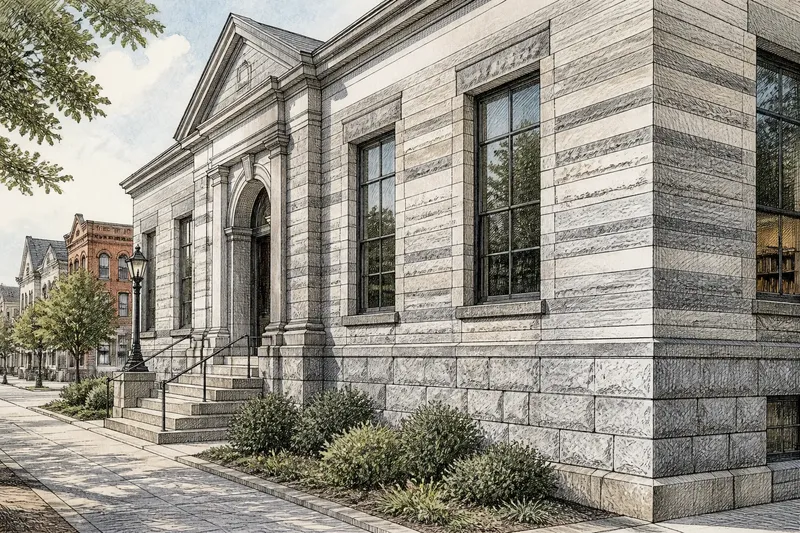
At the corner of an old storefront, a pale stone block may catch the morning light while the wall beside it stays cool and shadowed. Why local stone shapes a building’s surface becomes easier to see when you look closely at grain, color, and the forms a mason could cut from the material. These features do more than decorate a facade: they help determine how its parts meet and how the whole wall reads from the sidewalk.
What does local stone mean on a building?
Local stone usually means stone obtained from nearby quarries or a surrounding area, but the phrase can also describe material chosen because it suits a place’s established building supply. A building may combine stone from different sources, so a familiar appearance does not by itself establish where every block came from. The useful starting point is to observe what is visible and separate that evidence from assumptions about origin.
Stone is a natural material, not a uniform product. A quarry face may yield pieces with varied color, texture, layers, and soundness. Builders and stonecutters select and shape those pieces for different jobs: a large block may form a base, while smaller or more irregular pieces may fill a wall. The available material can therefore influence both the facade’s palette and the scale of its visible units.
Look for clues such as repeated color ranges, exposed mineral grains, bedding lines, and the size of individual blocks. These are observations, not proof of a particular quarry. Repairs, later additions, cleaning, and weathering can also change a wall’s appearance. If the stone’s source matters, a building record, local archive, or qualified stone professional can offer context that the facade alone cannot settle.
How does stone grain affect a facade?
Grain is the visible texture created by a stone’s mineral composition and structure. It may appear as fine speckles, larger crystals, streaks, bands, or small cavities. From nearby, these details give a wall visual texture; from across a street, they often blend into a broader impression of lightness, density, or movement.
Grain also interacts with light. A rough face breaks light into small highlights and shadows, while a smoother face reflects it more evenly. Crystal edges may glint in direct sun, and a banded stone can show lines that guide the eye across a wall or toward a doorway. A single block may therefore look different as the sun moves, without any change in its actual color.
Orientation matters, too. Layered or veined stone may be set so its natural lines run horizontally, vertically, or diagonally. Horizontal lines can reinforce the courses of a wall; vertical lines may emphasize tall openings or piers. The same stone can create a different visual effect when the blocks are turned, so notice whether markings continue in a consistent direction or shift from piece to piece.
For a clear reading, compare a section in direct light with one in shade, then step back. At arm’s length, you can distinguish grain and tool marks; farther away, you can see whether they gather into a consistent pattern. This change in viewing distance helps separate the stone’s individual texture from the larger composition of the facade.
Why do stone colors vary across one wall?
Color variation can come from natural differences between blocks, the way a stone was cut, surface finish, or later changes to the wall. A facade may range from warm cream to gray, or contain bands of darker material, without having been assembled from entirely different stone types. Natural variation is often easiest to see where blocks meet or where a sheltered section has kept a more even surface.
Cutting can reveal different parts of a stone’s structure. A face cut across layers may show lines or bands, while another orientation may expose a more even field. Weathering and deposits can also affect color, but they should not be treated as a reliable dating method. A shaded base, a sheltered recess, and a sunlit upper wall have different exposure, which can make the same material appear unlike itself.
Consider the pattern as well as the color. A gradual shift across a wall may reflect the selection and placement of blocks; sharp boundaries may mark a repair, an addition, or a change in finish. Look for seams, differences in joint width, and changes around windows. These details help identify where the surface changes, even when the reason remains uncertain.
How does a stone’s workable form shape the wall?
Workable form describes the sizes and shapes in which stone can be cut and laid for a building. Some pieces readily become squared blocks; others suit thinner slabs, rough-faced pieces, or irregular masonry. The resulting wall may show long horizontal courses, compact blocks, or a more varied arrangement. Each pattern changes the facade’s rhythm and the apparent weight of its parts.
Joints are part of that visual character. A wall of large blocks may have fewer, longer joints, while smaller units create a denser network of lines. The visible joint material can contrast with the stone or blend into it. Notice whether joints align from course to course, whether blocks are similar in size, and how the masonry turns at a corner. These features reveal how the surface is organized without requiring a technical inspection.
Different shapes also suit different architectural details. A broad, flat piece may form a sill or a step; a carefully shaped block can frame an opening or create a projecting edge. Such elements make transitions legible: the eye can see where a wall meets a window, where a base meets the pavement, or where a corner is reinforced. A stone’s workable form thus influences not just the field of the wall but the way its edges are expressed.
Say you are looking at an invented neighborhood library with a gray, banded stone facade. Imagine that its lower wall uses broad, squared blocks, while smaller pieces surround the windows and the bands run mostly across the building. You might infer that the stone’s cut and placement help give the base a grounded look and draw attention along the facade. Those are observations about the visible effect, not proof of the architect’s intention or the quarry’s location.
What should you look for when reading local stone?
A useful visual reading moves from small details to the whole building. Start near a doorway or corner, where exposed surfaces and junctions are often easier to see, then step back to judge the overall pattern. Avoid relying on one clue: color, grain, block size, and joint layout work together, and each can be affected by repairs or exposure.
- Grain: Note whether the surface looks finely speckled, crystalline, layered, or visibly porous.
- Color range: Compare several blocks and look for gradual variation, repeated bands, or an abrupt change.
- Block shape: Observe whether the masonry uses regular courses, elongated pieces, compact blocks, or irregular forms.
- Joint pattern: Follow the lines between stones to see whether they align, vary in width, or change around openings.
- Surface finish: Compare smoother faces with rougher ones and notice how each responds to light.
- Building details: Look at sills, corners, steps, and door surrounds to see how shaped pieces define transitions.
Keep descriptions concrete. “Gray blocks with pale horizontal bands” tells another observer what you saw; “stone from the nearby hills” makes a claim that needs supporting evidence. If a label, building record, or knowledgeable local source identifies the material, you can add that information while keeping direct observation separate from documented context. For repairs or conservation decisions, the appropriate material and method depend on the building and should be discussed with a qualified professional.
How can you tell whether a surface change is original?
A change in appearance may come from the original stonework, a later repair, a coating, or differences in exposure. Look for a combination of clues rather than deciding from color alone. A change that follows a clear boundary and also differs in block size, joint layout, or finish may indicate an alteration, but the visible surface cannot always tell you when or why it occurred.
Can color alone identify the stone?
No. Similar colors can occur in different stones, and one stone can vary in color across a wall. Grain, layers, block shape, and reliable building records provide better context when considered together.
Does rough stone always mean older construction?
No. A rough finish may be a deliberate choice on a newer building, just as an older wall may have smooth or renewed faces. Look at the whole facade and its joints rather than treating surface texture as a date marker.
Why does the same stone look different in shade?
Shade changes the amount and direction of light reaching the surface, which alters how grain and relief appear. Nearby materials, moisture, and deposits may also affect the visible color, so compare several parts of the wall before drawing a conclusion.
Can a facade reveal where its stone was quarried?
It may offer clues, but appearance alone rarely establishes a precise source. Quarry records, construction documents, or local expertise can provide confirmation when provenance matters.
To understand why local stone shapes a building’s surface, watch how its grain, color, and workable form cooperate: texture catches light, variation gives the wall a palette, and block shapes set its visual rhythm. A final useful check is to compare the building’s most exposed face with a sheltered corner. The contrast can reveal which qualities belong to the stone itself and which have been changed by the wall’s setting.