Cast, Forged or Cut: Reading Three Metal Finishes
Read cast, forged, and cut metal finishes by matching visible marks to the object’s shape, then describe its construction without overclaiming.
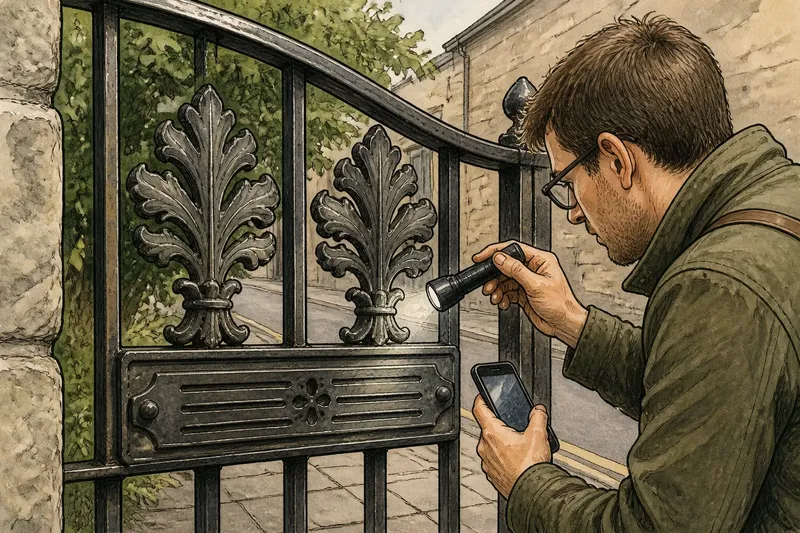
At a gate, identical flower-shaped ornaments sit beside a rail that bends into a smooth curve. Reading cast, forged, and cut metal finishes starts with those differences in form: each process shapes metal in a distinct way, and one object may combine several.
The most useful description separates what you can see from what you infer. A groove is an observation; saying it was machined is an interpretation. Keeping those two ideas distinct lets you describe a piece precisely even when its full making history is out of view.
Read the object before naming a process
Start with the object’s function and overall shape. Repeated, sculptural ornament may suit casting; a curved hook or tool head may have been forged; a flat plaque with crisp lettering may show cutting or engraving. These are starting points, not rules.
One metal object can combine methods. A cast bracket might have a cut mounting face, while a forged bar might be sawn to length and filed smooth. Name the process that best explains each feature rather than assigning one method to the entire piece.
Use a phone camera and a small flashlight to examine details without touching the finish. Hold the light at a low angle to bring out shallow ridges and grooves. Compare separate areas, including edges and recesses already visible; do not scrape paint or remove a coating.
Casting often carries repeated relief
Casting forms metal in a mold, where it cools into a solid shape. The process can produce complex volume and repeated decoration, making it useful to consider when matching ornaments appear on balusters, brackets, or hardware.
Look for raised details that seem integrated with the body, rounded transitions, or recessed patterns. A seam may mark where mold sections met, but finishing can soften or remove it. A small cavity or rough patch is not enough by itself to identify casting.
Compare several pieces where possible. If matching ornaments share the same complex profile, casting becomes a plausible explanation. Describe the visible feature first—“matching raised leaf motifs,” for instance—if only one face is accessible.
Forging follows the shape of the metal
Forging shapes metal through pressure or blows, commonly while it is hot. A bar may narrow toward a point, curve along its length, or broaden into a tool head. Hammer facets can remain as uneven planes, though finishing may remove them.
Follow a bend or transition rather than judging only the broad face. A handrail with slight asymmetry might have been forged, but unevenness is not proof: other production methods, fitting, and later repair can also alter a shape. A smooth surface does not rule out forging.
When visible marks and contours both follow the metal’s length, forging may be a good fit. If a coating hides the surface, leave the process uncertain rather than disturbing the finish to look underneath.
Cutting leaves edges, grooves, and fitted planes
Cutting removes material to create a shape or surface. Depending on the tool and material, it can leave saw lines, sheared edges, drilled holes, milled grooves, or crisp lettering. Look for straight marks, sharply defined corners, or a flat face that interrupts a rougher area.
A clean edge can also result from filing or grinding after casting or forging. Check whether the feature forms a functional boundary, a decorative line, or part of a repair. “Cut mounting face on a cast bracket” may describe the evidence more accurately than calling the whole bracket cut.
Match each clue to its location?
Can one object be cast, forged, and cut?
Yes. A broad shape may be cast or forged, then cut, drilled, filed, or ground to finish it or make it fit. Describe each visible area separately when the clues point to different processes.
Do hammer marks prove that a piece was forged by hand?
No. Hammer-like marks can come from finishing or later wear, and polishing can remove marks left during forging. Compare their direction and position with the object’s shape before considering what they suggest.
Does a seam mean an object was cast?
A seam can be consistent with a mold, but a joint, welded repair, or assembled part can also create a line. Check its location and look for other features that support the casting interpretation.
What should you do when the clues disagree?
Record each feature with its location, such as “parallel grooves on the front face” or “rounded line along the back.” If a surface is hidden, leave the overall process unresolved rather than treating an unseen area as known.
Use a surface checklist to choose careful wording
For each observation, decide whether it supports a process, points elsewhere, or leaves the question open. These checks help keep the description tied to visible evidence.
- Repeated ornament: If matching relief appears on several parts, consider casting; if the forms differ or only one is visible, describe the ornament without assigning a process.
- Rounded transitions: If raised details flow into a bulky body, consider casting; if a clear join separates them, describe the join and leave the forming method open.
- Lengthwise contour: If a bar narrows or bends along its length, consider forging; if the contour does not show that pattern, inspect another area before deciding.
- Uneven facets: If facets follow a bend or change in thickness, consider forging; if they occur only at a worn edge, describe the wear rather than treating them as forming marks.
- Straight grooves or crisp edges: If these define a face, hole, or letter, consider cutting or engraving; if they appear only where a part was repaired, describe them as local marks.
- Visible seam: If the line follows a plausible mold boundary and other casting clues are present, casting may fit; if it crosses a joint or repair, describe that location and avoid calling it a mold seam.
- Paint or plating: If a coating hides the underlying texture, record the surface as obscured; if an exposed edge already offers a clear clue, examine that area without removing the coating.
Say you are looking at an invented street-side gate with identical leaf ornaments, a gently bent top rail, and a flat plate whose letters have narrow grooves. First, you note the repeated raised leaves and treat casting as a plausible explanation. Next, you follow the rail’s bend and describe its curve, but leave forging uncertain because the visible surface has no clear shaping marks. Finally, you record the grooves in the plate lettering and call cutting or engraving plausible. The resulting description distinguishes the parts without claiming a maker or a single process for the gate.
Write notes that another observer can check
Useful notes name both the feature and its location: “parallel grooves across the plate face,” “a rounded line along the bracket’s back,” or “uneven facets at the rail’s bend.” These details let another observer assess the interpretation without relying on a bare label such as “forged.”
For a painted, plated, polished, or heavily worn object, describe that condition before interpreting marks. If close examination of a valuable or fragile piece matters, consult a conservator or qualified metal specialist rather than altering its surface. To read cast, forged, and cut metal finishes, match each visible feature to the shape and location where it appears; the most useful account may identify several processes and leave some parts unresolved.