Brass Hinge Apprenticeship in Birmingham’s Jewellery Quarter
Brass hinge apprenticeship in Birmingham’s Jewellery Quarter shows how bench practice, tool marks, and careful fitting connect a crafted object to place.
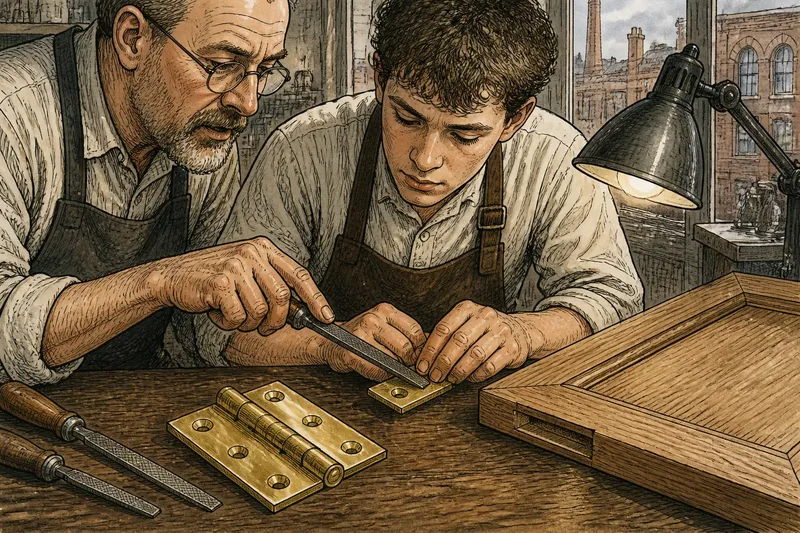
A brass hinge rests beside a wooden cabinet door in Birmingham’s Jewellery Quarter, its bright edge catching the workshop light. To understand how such details carry local craft knowledge, look not only at the finished metalwork but also at the bench practices used to shape, fit, and inspect it. Brass hinge apprenticeship offers a way to connect a small object with the people, tools, and working traditions of a place.
The scene here is an invented, hypothetical teaching situation, not a claim about a particular historical workshop or maker. It uses a brass hinge and cabinet fitting to show how a learner might acquire a craft through demonstration and supervised practice, while keeping Birmingham’s metalworking district as the material setting rather than treating every workshop as interchangeable.
Birmingham’s Jewellery Quarter gives small metalwork a local setting
The Jewellery Quarter is a Birmingham district associated with jewelry making and related metal trades. Its name points to a concentration of craft and commerce, but it should not be taken to mean that every local shop made the same objects or followed the same training customs. A brass hinge belongs to a wider world of metal fittings; its connection to place comes from the makers, suppliers, workshop buildings, and neighboring trades involved in producing and using such work.
That distinction matters when reading an object. A hinge may reveal choices about alloy, finish, shape, and fit, but it cannot by itself identify the maker or prove how that maker learned. Local context helps frame useful questions without turning a plausible workshop scene into undocumented history.
A hinge teaches the relationship between metal and wood
A hinge is a working detail: its leaves attach to separate surfaces, while its pin allows movement. For a cabinet door, the metal must sit neatly against the wood and move without binding. The task therefore asks a craft worker to consider both materials, not merely to produce an attractive piece of brass.
In the imagined workshop, a craft worker shows a learner a prepared hinge leaf and points out a rough edge left by earlier shaping. The learner watches the hand file travel along the edge, then examines how the file meets the brass and where the worker pauses. The lesson is specific to this object: the learner must smooth the edge without altering the flat face that will sit against the wood.
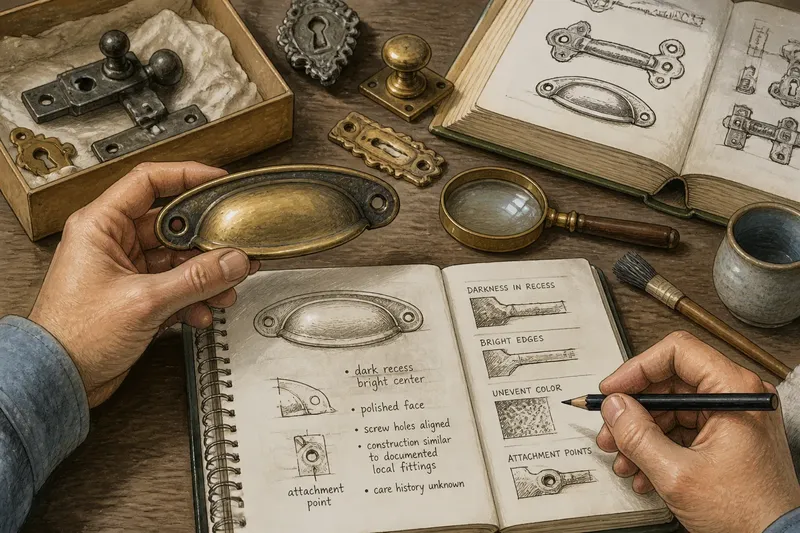
The tool marks and fitting surfaces can also help a viewer ask better questions about an actual hinge. Are the edges regular? Does the finish differ on a hidden surface? Are screw holes aligned with the intended mounting? Those observations may suggest stages of making or later repair, but they do not establish a date or origin without reliable supporting evidence.
Apprenticeship turns observation into a judgment about fit
After the demonstration, the hypothetical learner practices on a scrap of brass before touching the hinge. The craft worker asks the learner to stop, inspect the edge under a bench lamp, and compare it with the prepared piece. A file stroke is not judged only by how it feels; the resulting surface must suit the next operation.
That comparison makes the learning concrete. The apprentice is not just copying a hand movement. The learner is connecting the movement to a visible result and to the hinge’s eventual contact with a wooden cabinet door. In a real workshop, the precise order of operations and the tools used would depend on the object, equipment, and maker.
Imagine the learner has a scrap brass blank, a hand file, a bench lamp, and a prepared hinge leaf. First, the learner files the blank’s rough edge with short, controlled strokes. Next, the learner turns it under the lamp and notices one bright burr still catches the light. The craft worker demonstrates a flatter file angle; the learner repeats the action and checks again. The resulting decision is whether the edge appears even enough to proceed to a supervised fit check, or whether another pass is needed. This example illustrates a possible lesson, not a documented Birmingham apprenticeship.
Supervised fitting connects craft skill to a built detail
Once the edge appears ready, the learner in the invented scene brings the hinge to a prepared cabinet door. The craft worker supervises as the hinge is placed against the wood. If the leaf rocks or an edge catches, the learner stops rather than forcing it into position. The craft worker then identifies the contact point, and the learner makes a limited correction before checking again.
This moment links metalwork to the built environment. A hinge is easy to overlook when a door opens smoothly, yet its proportions and placement affect how the cabinet functions. The detail is shaped by the relationship between metal, joinery, and use—not by metalworking alone.
For someone examining an old cabinet or architectural fitting, practical clues include wear around the pin, screw-hole placement, and differences between exposed and sheltered surfaces. Such clues can guide description and comparison. If an object’s age, maker, or conservation needs matter, consult a qualified conservator or relevant local museum rather than relying on visual clues alone.
What can a brass hinge reveal about place and learning?
Why connect brasswork with Birmingham’s Jewellery Quarter?
The district provides a specific setting associated with jewelry and related metal trades, making it more informative than a generic workshop backdrop. That context suggests questions about local makers and neighboring crafts, but it does not prove that any particular hinge was made there.
What can tool marks tell you about a hinge?
Marks, finish, and fitting surfaces can help describe how an object was shaped, used, or repaired. They are clues rather than conclusive evidence of a maker, date, or training tradition.
How does an apprentice learn to judge a fitting?
A learner can compare a worked surface with a prepared example, observe whether it sits correctly against the wood, and ask for review when contact is uneven. The craft worker’s correction ties the visible result to the next stage of work.
Did every Birmingham workshop train learners in the same way?
No single account should stand for every trade, workshop, or period. Training could vary with the object, workplace, people involved, and available tools; a specific historical claim needs evidence about that particular setting.
Read the object carefully without making its history up
A brass hinge can connect regional material culture to everyday use: metalworking meets joinery at a small point where a cabinet door must move. In the invented scene, the learner progresses from watching a file stroke to checking an edge and making a supervised fit decision. That sequence offers a clear model of learning, while leaving room for the many actual ways Birmingham craft workers may have learned and worked.
When describing a hinge from the Jewellery Quarter or another place, separate what is visible from what is inferred. Record its material, form, finish, wear, and relationship to the wood; then seek catalog, workshop, or conservation evidence before assigning a maker or history. This habit preserves the useful connection between object and place without asking a small piece of brass to tell a story it cannot support.