The Patina Myth: Age Does Not Explain Every Surface
Patina alone cannot date an object. Learn how to describe surface changes, preserve useful evidence, and distinguish visible details from uncertain history.
At a flea market, a brass key with dark grooves and bright edges can look older than the hand holding it. Patina—the visible change or coating on a surface—may reflect age, but it can also come from use, storage, cleaning, or a finish applied during manufacture. The useful question is not simply how old the key looks, but what its surface can and cannot tell you.
Patina records conditions, not a single moment
People use patina for many kinds of surface change: tarnish on copper alloys, oxidation on iron, softened edges on wood, or a film of grime and polish built up through handling. The word can also describe a finish deliberately applied to make a new object look muted or timeworn. Similar appearances can have different causes.
A surface may change in a damp shed, a dry drawer, or a busy household. Material, moisture, salts, cleaning products, and handling all affect what develops. That is why color alone is a poor clock: it does not reliably reveal how long a change took or what caused it.
For regional material culture, this distinction helps keep a fitting’s appearance separate from its place in a local tradition. A darkened latch may resemble fittings associated with an older building style, but that resemblance does not establish when the latch was made or installed. Its setting, construction, documentation, and relationship to nearby details matter too.
Describe the surface before interpreting it
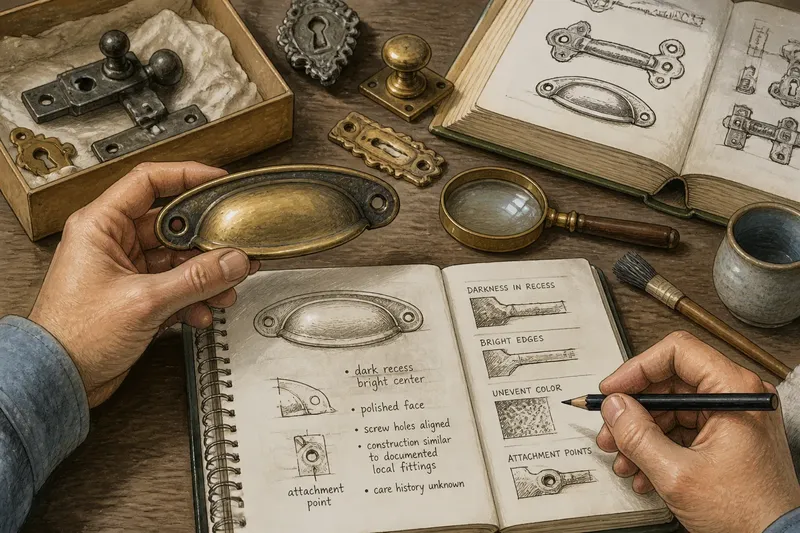
Begin with visible details, not a story about their cause. Note where the color changes, whether the texture looks smooth or granular, and whether marks appear around areas touched by a hand or tool. A notebook sketch or a clear photograph in even daylight can preserve these observations before anyone cleans or handles the object further.
- Darkness in recesses: Check whether the dark area follows grooves or lettering. If it does, record its location and leave it in place; if it does not, photograph the broader pattern as well, because a patch alone may have several explanations.
- Bright edges: Check whether raised corners and likely contact points are bright. If the pattern follows plausible contact, note that it is consistent with rubbing; if it does not, consider cleaning or a made finish as alternatives and avoid calling it proof of use.
- Uneven color: Compare sheltered and exposed areas. If they differ, record both locations without assigning a timeline; if they do not, document the overall color and texture instead.
- Surface buildup: Look for a visible film, flakes, or residue without scraping. If material is loose or the object is significant, stop handling and seek a qualified conservator; if the surface is stable, photograph it and note that its composition remains uncertain.
- Attachment points: Check for screw holes, worn slots, or changes around a hinge or handle. If those details differ from the surrounding material, record a possible repair without naming its date; if they align, note the relationship as an observation rather than proof that all parts are original.
- Nearby examples: Check whether related objects have documented settings or collection records. If construction and context also resemble the object, record the comparison and its source; if only the color matches, treat the resemblance as a starting question, not an attribution.
These checks help organize observations; they are not a diagnostic key. A useful interpretation accounts for several features and leaves room for alternatives. If a proposed story rests on one dark patch, describe the patch rather than asserting the story.
Separate manufacture, use, and later care
An object’s present condition can combine several periods of activity. A maker may brush, burnish, paint, or chemically darken a surface. A later owner may polish exposed areas, apply wax, or replace a fitting. Storage and weather add further changes. What you see may be a layered record rather than a finish preserved from one moment.
Say you are documenting an invented brass drawer pull from a local collection. It has a dark recess and a bright center; the owner says it was kept in a box and polished before display, but has no earlier care records. You photograph the pull, note the two surface patterns, and compare its attachment points and construction with fittings shown in a documented building inventory. The inventory supports a comparison of form, while the unknown polishing history leaves the surface’s cause unresolved. Your resulting description might read, “Brass pull with a darkened recess and polished face; care history incomplete; construction resembles documented local fittings.” That wording preserves the useful comparison without turning resemblance into a date.
Comparison is most informative when the other object has a known context. Construction details, tool marks, and documented provenance can support a closer relationship than color alone, but they still do not establish that two pieces came from the same workshop or period.
Imitation and repair can change the clues
Makers sometimes create aged-looking finishes with dark wax, tinted coatings, controlled oxidation, or rubbed paint. These treatments can be deliberate design choices, not attempts to mislead. The difficulty comes when an appearance is mistaken for a record of elapsed time.
Restoration adds another layer. A repairer may clean a surface, stabilize loose material, repaint a detail, or apply protection. Such work can preserve an object while changing how its surface appears. Treatment notes help distinguish original material from later work; without them, appearance may not settle where one ends and the other begins.
Wear can also matter for reasons beyond age. A worn threshold or handled tool may be valued because of its role in a community or household. That significance can be described through the object’s known setting and visible condition without assigning an unsupported date.
What can patina tell you about an object?
Can patina tell me how old an object is?
Not on its own. Surface changes depend on material, surroundings, use, treatment, and storage, so a similar appearance can arise under different conditions.
Does uneven wear prove an object was used?
No. Uneven wear may fit a pattern of handling, but polishing, display, repair, or a deliberately varied finish can create similar contrasts. Check whether the marks make sense for the object’s function, then record that interpretation as a possibility rather than proof.
Should I clean a surface to see what lies beneath?
No; cleaning can remove coatings, residues, or fragile evidence and may cause lasting damage. Leave an important or unfamiliar object undisturbed and consult a qualified conservator before treatment.
What evidence can support an interpretation?
Documented provenance, construction details, tool marks, material identification, and comparison with well-recorded objects can contribute to a stronger assessment. Each clue has limits, so consult a qualified specialist if a firm attribution matters.
Write field notes that keep observation distinct
Choose words that report what you can see before naming a material or cause. “Green deposit along the hinge” describes a visible condition; “aged copper hinge” adds claims about material and time that may not be established. If a surface appears intentionally darkened, record its appearance without naming a process unless you have supporting evidence.
For each note, record the object’s location, the visible feature, its color and texture, and any nearby marks that could matter, such as a repaired edge or attachment hole. Add what remains unknown, including cleaning or storage history. If you can photograph the object without moving or altering it, keep the images with the notes; otherwise, prioritize leaving a fragile or fixed object undisturbed.
For example, “Dark film in recessed lettering; raised edges brighter; cleaning history unknown” gives a future reader specific details to compare. It does not date the object, but it preserves the observations on which a more careful interpretation could build.
Let the surface guide the next question
Patina is most useful as one part of an object’s material record. It may prompt questions about exposure, handling, maintenance, or a chosen finish, but answers depend on construction, context, and documentation as well as appearance. A cautious description keeps what is visible separate from what is inferred.
When you encounter an intriguing surface, preserve its condition and note where its features occur. The search phrase patina on objects can lead to useful background, but for a specific object, a record of its setting, repairs, and related fittings will give a specialist more to work with than color alone.